Is Using an Anonymized Face Dishonest? Where the Line Is
No. An anonymized face is a privacy persona, like a stage name. Here’s where it would cross into deception, and how to be open with fans without exposing yourself.
- face-anonymization
- ai-disclosure
- faceless-creator
- creator-privacy
No. Using an anonymized face to keep your identity private is no more dishonest than performing under a stage name: you choose how you appear, while the content, your voice and your performance stay yours. It becomes dishonest only when you use it to tell people something false, such as calling it your real face, borrowing someone else's face, or leaving out an AI label a platform asks for.
Why do creators hide their real face?
Most creators who keep their face out of their content aren't hiding anything from their fans. The biggest reason is social pressure: creator work, adult content especially, still carries a stigma, and being recognized can cost someone a job, a family relationship or their place in a small community. Others are avoiding an ex or a stranger who goes looking. A face is one of the quickest ways to link a creator account to a real name, and once that link exists it's very hard to undo. The guide to how creators get doxxed walks through the ways people get found.
Cropping, masks and blur all protect you from that, but they leave fans looking at a headless body or a blurred oval. An anonymized face makes a different trade: fans see a face, and the people in your real life don't see yours.
That reason matters for the honesty question. Keeping your identity to yourself is a boundary, the same one a novelist keeps by publishing under a pen name. It doesn't say anything false about you.
What makes something dishonest?
Plenty of things create a gap between what people see and what's real. Makeup, lighting, flattering angles and stage names all do, and nobody calls them lies. A more useful test comes from consumer-protection law. The US Federal Trade Commission's policy statement on deception looks for a claim or omission that is likely to mislead a reasonable person about something that matters to their decision.
Two parts of that test do most of the work here:
- Is anything false being claimed? A privacy face doesn't make a statement on its own. Saying "this is my real face" does.
- Does it matter to the person's decision? Fans pay for your photos, videos, chat and personality. Your legal name, your home town and the face on your passport were never part of the deal, which is why stage names are normal across entertainment.
Imagine a creator who posts as "Juniper" with an anonymized face. A subscriber sends a message: "Is that your real face?" If Juniper replies, "It's a privacy face. The content is all mine," nothing false has been said and Juniper's identity stays private. The reply to avoid is "Yep, 100% me." It's the only untrue thing in the whole setup, and it doesn't make Juniper any more private.
So the line depends on what you say about the face, not on the face itself. An anonymized face does go further than makeup, though. Makeup changes how you look on a good day; anonymization changes who you appear to be. That's why a short note is worth adding. It removes the one assumption a fan could reasonably make, and it costs you nothing in privacy.
Is using an anonymized face catfishing?
No. Catfishing means building a fake identity to pull someone into a relationship, usually to get money or attention out of them. The FTC's romance scam warning describes the pattern: scammers create fake profiles, make up a story and ask for money.
The fake photo is the smallest part of that. What hurts people is the invented life: the sick relative, the plane ticket that needs paying for, the promise to finally meet. A creator who sells content and chats as a persona isn't running that playbook. Fans are paying for content and conversation, and the persona is part of the entertainment.
It would turn into catfishing if you paired the face with made-up personal stories to win someone's trust or money. Claiming an emergency so a regular sends a gift, or promising to meet someone you never intend to meet, is dishonest with or without an anonymized face.
Is an anonymized photo "AI slop"?
Merriam-Webster picked "slop" as its 2025 word of the year and defines it as low-quality digital content produced, usually in quantity, by artificial intelligence. That describes content a model invents from a prompt: the scene, the person, the story.
Face anonymization works the other way round. You plan the shoot, you perform and you edit. The model then replaces one thing in the finished frame, the face. Your body, clothes, hair, the room and everything you do on camera come from your own footage, and a processed video keeps your original audio.
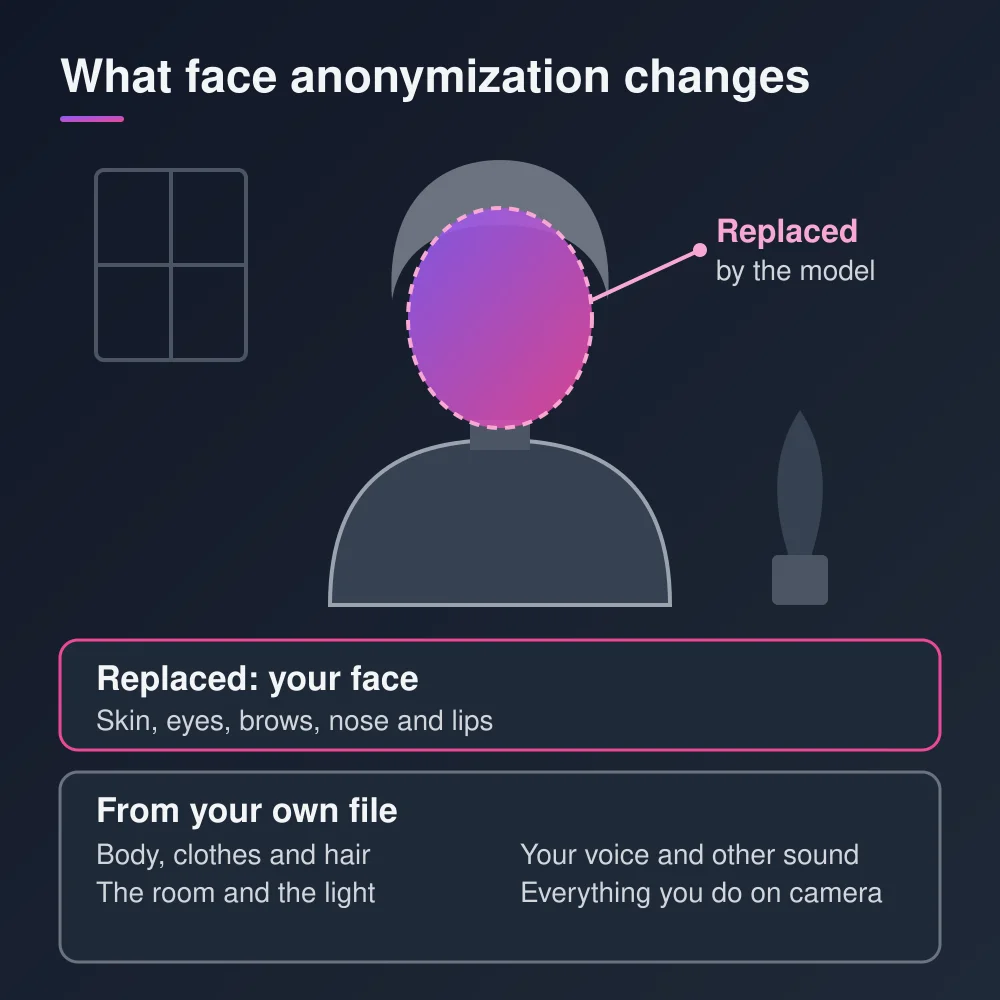
That's also the difference between an anonymized face and an AI avatar. An avatar generates the presenter, while anonymization keeps your performance and changes who it appears to be. The face anonymization vs AI avatars guide covers that choice if you're deciding between them.
Where is the line? Common situations
Most cases fall clearly on one side. The one that needs a little care is posting with no mention of the face at all.
| Situation | Honest? | Why |
|---|---|---|
| Privacy face, with a bio line saying the face is anonymized | Yes | Nothing false is claimed, and fans know what they're looking at |
| Privacy face, with no mention anywhere | Usually, but add a note | You haven't claimed it's your real face, but a fan could reasonably assume it is. One line in your bio closes that gap |
| A fan asks "is that really you?" and you say it's a privacy face | Yes | It's true, and your identity stays private |
| A fan asks and you say "yes, that's my real face" | No | It's untrue, and "it's a privacy face" keeps you just as private |
| Using a celebrity's, an influencer's or a friend's face | No | It borrows a real person's identity without their say |
| Putting the anonymized face through an ID or age check | No | Verification exists to confirm the real you |
| Inventing an emergency to get gifts or money | No | That's catfishing, whatever face you use |
| Leaving out an AI label a platform asks for | No | On that site, the label is part of being honest |
How to be open about it without exposing yourself
You can be completely clear about the face without giving away anything about who you are.
Say it once, where fans will see it. A short line in your bio does the job: "Face digitally anonymized for privacy." You don't need to say how it's done, which tool you use or why you want privacy.
Use the platform's label where there is one. TikTok and YouTube both have upload settings for realistic AI changes, and the AI labels guide shows where to find them and how to word the explanation. A label describes the edit. It doesn't decide whether the edit is allowed, so read each site's current rules on AI-altered content before you post there.
Keep one face. Switching faces from post to post makes the persona harder to recognize and harder to trust. Pick one and keep it, the way you'd keep a stage name. The consistent persona guide covers the rest of the look, from hair to backgrounds.
Have your answer ready. Fans will sometimes ask. "It's a privacy face, the content is mine" is true, short, and doesn't invite questions about your real life. You never owe anyone your legal identity. You just shouldn't say yes when the true answer is no.
Keep the face out of your offers. No "face reveal" bundles and no "see my real face" upsells built on the anonymized version. If you ever decide to show your real face to paying fans, treat that as a separate decision with its own privacy risks.
Before you post with a privacy face
- My bio or profile says the face is anonymized, or I know exactly how I'll answer if someone asks.
- I use the same face across my posts.
- My captions, messages and offers never call it my real face.
- I've set the AI label on each platform that asks for one.
- I've read each site's current rules on AI-altered content.
- Identity and age checks use my real face and documents, never the anonymized one.
Frequently asked questions
- Do I have to tell fans my face is anonymized?
- You don’t have to explain who you are or why you keep your face private. A short line in your bio, such as “Face digitally anonymized for privacy,” is the simplest way to remove any doubt about the face itself. Some platforms also ask for an AI label on realistic edited video, so check each site’s upload settings too.
- Is it dishonest to show my real face to paying fans and an anonymized face in public?
- Not if you’re clear that the public face is a privacy face. Fans who later see your real face are much less likely to feel tricked if your public profile already said the face was anonymized. Keep in mind that paid content can be saved and reshared, so anything showing your real face carries a privacy risk.
- Does NeoFace change anything besides my face?
- No. NeoFace replaces the face area. Your body, clothes, hair, the room and everything you do on camera come from your own photo or video, and a processed video keeps the original audio.
- Can I use a celebrity’s face if I label it as AI?
- No. A label tells viewers that a face was changed. It doesn’t give you the right to use a real person’s identity, and putting a recognizable person’s face on your content misleads people about who they’re watching. NeoFace doesn’t support it either: you can’t upload another person’s photo as the new face, and you pick from faces NeoFace suggests.
- Will fans be able to tell my face is anonymized?
- Sometimes. Results vary with lighting, angles and movement, and some viewers look closely. Don’t plan around it never being noticed. Saying it up front means there is nothing to discover.
Create with
a face you choose.
Choose a reusable synthetic face for your photos and prerecorded videos. Start with a sample to see how NeoFace fits your content.